For much of my life, I've lived in a fairly remote rural area. There, I'm lucky enough to have a good location and a good water supply. And at the heart of that water supply system is an extraordinary device – a hydraulic ram pump. I don't think many people would have come across one of these. It is a very simple device, but an extremely effective one. It has no motor, no external power source. It just relies on the energy from gravity that's already available on site and a simple but robust infrastructure around it to deliver water to where it is needed.
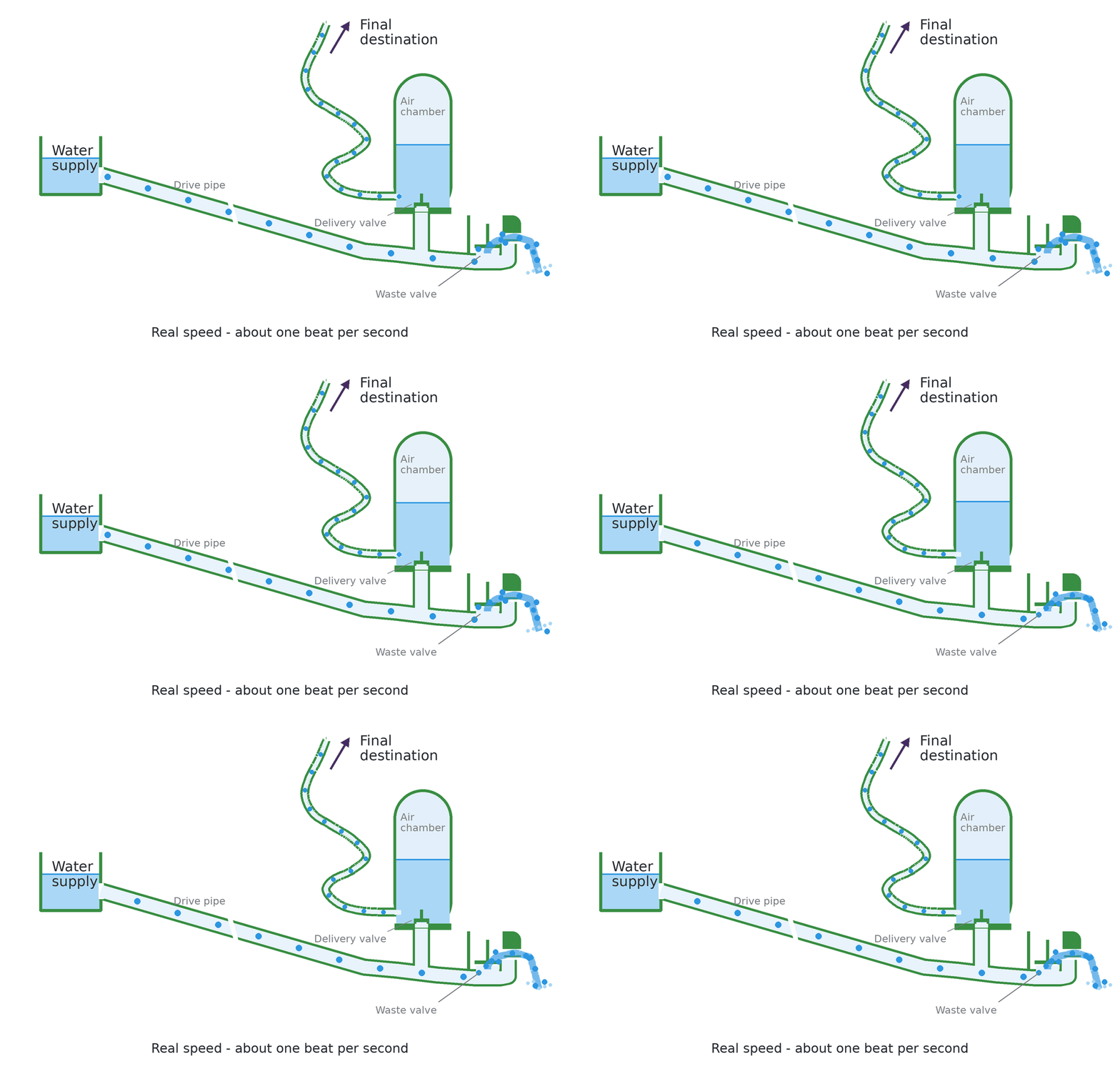
Building on a principle described by John Whitehurst in 1772, the hydraulic ram pump was invented by Joseph-Michel Montgolfier in 1796 to supply water to the family paper mill. He was one of a famous pair of inventor brothers. They were also pioneers of flight with hot air balloons (which actually look a bit like a ram pump). Two quite extraordinary devices: effectively one defying gravity and one making use of it. But neither design has changed in any fundamental way since.
According to Green and Carter Ram Pump Manufacturers records, my own pump was supplied through North and Co, an agricultural supply company in Durban in South Africa, in 1961. Since it was installed on the property that year, it has been working consistently. Occasional droughts have slowed it down, and there has been some flood damage. Each time, with a little maintenance and an occasional refurbishment, it has been brought back online and carried on doing its work. Over the years I’ve been advised more than once to replace it with something newer and supposedly more efficient - a solar pump, an electric pump, in earlier times a diesel pump. The advice usually came from people who knew the least about the system, but had the most confidence about how to improve it. I’ve resisted, because the pump provides everything I need. And it does more - it offers some very useful lessons. The key to how a ram pump works is that it is steady and consistent. One beat per second does a surprising amount of work, in my case, pumping 10 to 20 litres per minute, 600 litres per hour, 24 hours a day, 365 days a year.
I've been thinking a lot about that pump recently. That's not because anything has gone wrong, but because the climate scientists and forecasters and my own weather records tell me what is coming. We have a very strong El Niño developing, and experience tells me that will mean very low flows, probably for an extended period. These are conditions the pump has handled before, but only when everything is working properly.
That means while the conditions are still reasonable, I need to do something. I need to check the supply pipe for leaks. In normal years this isn't a huge problem, but in drier than normal conditions a leak is a waste and a loss of efficiency. I need to discuss with the landowners upstream and ensure that the small normal flow release from their reservoir is maintained. That's a conversation that takes time, is based on years of goodwill, and it's not something that can be rushed.
I need to modify the penstock (the supply pipe and collection sump) slightly, so that the pump can keep working in lower flow conditions than it has experienced before. I'm not panicking about this, but it is urgent if the water supply is to be maintained. It must happen now, because I cannot influence when the El Niño will affect the property and when its impact is going to be felt.
So what does a technology more than 200 years old have to teach us about change in the modern era? In my day-to-day life, I'm working in an organisation undergoing change. I think there are lots of lessons we can consider, but here are four:
Steady and urgent are not opposites. Change takes time. There may be a tendency to rush in, make dramatic changes, and focus on urgency rather than long-term sustainability. But the reality is that much can be done by working steadily, consistently, and not panicking. I cannot adjust the pump's pulse and rhythm. The physics simply doesn't allow it. But that steady one beat per second, continuously maintained with no interruption, produces an incredibly effective cumulative result. So the lesson is not to be slow. It's rather to recognise that change is needed, that urgency does not mean panic, and that the steady beat can do the work needed.
We are not immune to the outside world. A ram pump's supply depends entirely on what happens upstream. The pump does not control the rainfall, the land use influencing the runoff that reaches it, the neighbours' operation of the reservoir. In the same way, in organisations, we usually do not control the forces acting on us. But we can work to influence them.
Globally, the funding environment that has sustained many institutions for decades has shifted. Like many, we are now in a period where upstream conditions are harder. For years, we could tolerate inefficiencies because the funding was flowing and there was enough capacity to absorb them. That is no longer true. Like the El Niño, we can see this coming. It's already affecting us, and we need to respond.
Fix the leaks while you still can. A dry season will expose everything that wasn't fixed in a wet one. In a normal year, a small leak in the supply line is an inconvenience. Something that can be lived with. But in a dry year, that leak can be the difference between having water or not. So the pump's 65 years of reliable service have not just happened. Like all our infrastructure, it needs maintenance, care, and occasional refurbishment at the right time. It's a fundamental that we tend to forget, and it puts any investment or structure at risk.
Similarly, in many organisations (warning management speak coming), the “soft infrastructure” — the people, the policies, the working environment — have lost their effectiveness. Things that should have been maintained were not. Decisions that should have been made were deferred. In better years, when funding flowed well, that was manageable. But when funding dries up, or when times are lean, the failure to act becomes far more apparent and the consequences more severe – especially for the people in the organisation – and unlike the pump, there is more at stake than steel and water.
Unfortunately, in many organisations that change happens too late, and the consequences can be dire. So the challenge is to make the hard decisions at the right time, and not gear them to the conditions we know, but for the conditions we are moving to.
Sometimes you actually have to stop the pump to fix it, but that needs a backup and a clear plan of how and when to restart it. Perhaps this is the most difficult part of a change process: a deliberate choice to make a change, accepting that this will temporarily reduce capacity — and then investing quickly in that space to maintain the momentum of the change.
The resources we need already exist. The ram pump only needs water and gravity and some simple infrastructure around it. That's already there in the system. It cannot wait for something better to arrive. In many change projects, there's an assumption that the right conditions, the right consultant or the right people must arrive before the work begins or to make it happen. They rarely do - and the advice to bring in something new often comes from those who know the system least, yet somehow carries the most weight in the decision. The resources, the people and the relationships are what is available, so often, everything needed already exists. Dedicated staff, loyal partners and stakeholders, long-term relationships with funders. So the question is often not — do these resources exist and are they the right things — but whether and how to use them effectively.
My pump was installed in 1961. It has been delivering water for 65 years. It survives not because it is a new technology — its design is more than 200 years old. But because it is robust, it is maintained and adaptations are made when conditions change. And because of that, it keeps beating through the difficult years as well as the easy ones.
That is something from which we can learn as we undertake change in our organisations. A steady beat, still urgent, the right people and prepared for the future. There are worse models for organisational change than that.